

The biological window, and what reaches each depth
Red light therapy, or photobiomodulation, uses specific wavelengths of light to support the cellular energy production your body already runs on. Here is the full picture, done properly.
What the light actually does, step by step
The full cascade, from a photon entering the skin to a cell with more energy. This is the leading and most-studied explanation of how photobiomodulation works.
The biological window, and what reaches how deep
Between roughly 600 and 1000nm, light passes through tissue rather than being absorbed at the surface. Below about 600nm it is absorbed by skin pigment; above about 1100nm it is absorbed by water. Inside that window, wavelength sets how deep the light reaches.
660nm addresses skin-level goals while near-infrared reaches deeper tissue. Combining multiple wavelengths covers the full depth range in a single session, which is why multi-wavelength systems reach more than single or dual-wavelength panels.
The science, in ninety seconds
A short explainer walking through the mechanism above.
The science is only as good as the diode
The wavelengths and doses above only hold if the light source is accurate. TheraLuma uses premium LED diodes, OSRAM diodes in the FlashHeal, chosen for wavelength accuracy and consistent intensity rather than the unverified generic diodes many panels rely on.
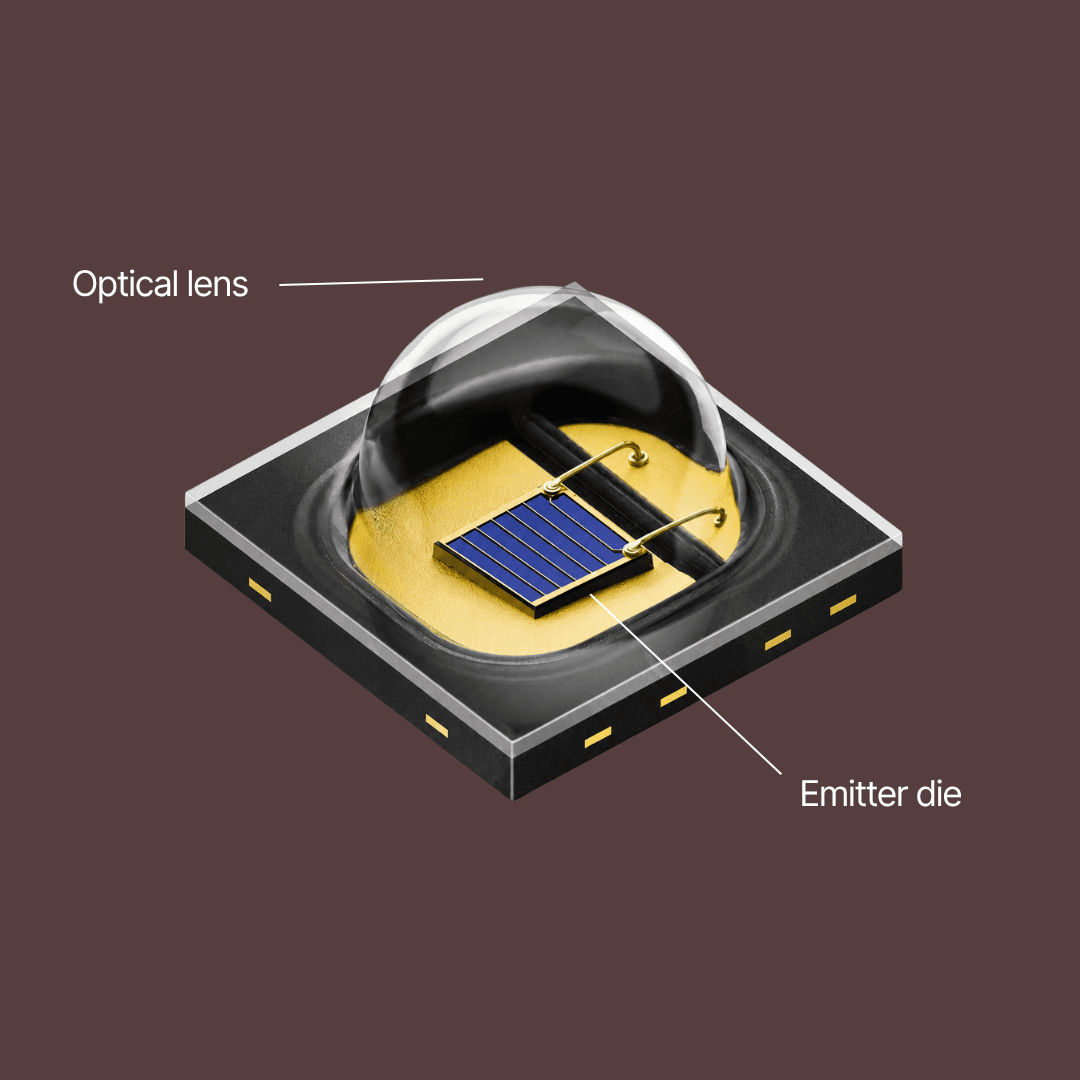
Wavelength precision
A cheap diode drifts off its stated nanometer. Premium diodes hold their wavelength, so the light actually does what the spec says.
Consistent irradiance
Output stays even across the whole panel, so the dose is the same wherever you sit under it.
Longevity
A rated LED lifespan of 100,000 hours, with thermal management and reliable electronics behind it.
Built per application
Custom-built for the job rather than one generic panel resold to everyone. Made and assembled in the USA.
Verified, not claimed
More is not better. Enough is better.
Irradiance is the thing to check
Irradiance (mW/cm²) is power density: it determines whether enough energy actually reaches the target cells. A clinical-grade benchmark is roughly 30 to 100 or more mW/cm² at a realistic 6 to 12 inch distance. Low irradiance means sitting for hours to get a response.
The biphasic dose response
The Arndt-Schulz principle: there is a therapeutic window. Too little does little, and past a point, more can give less. Dose is simply irradiance multiplied by time, measured in joules.
The FlashHeal delivers independently verified greater than 100 mW/cm² at 6 inches, and reaches 50J in under 7 minutes. Its presets target the effective range so you do not have to do the math.
Enough energy to be useful, without overdoing it. This is where the presets aim.
The effects are cumulative
Photobiomodulation is associated with changes that build over time. Most goals follow an active phase in the first 12 weeks, then settle into ongoing maintenance. Consistency matters more than any single session.
| Goal | First Changes | Lasting Results | Frequency |
|---|---|---|---|
| Muscle Recovery / DOMS | 1 to 2 sessions | 2 to 3 weeks | Post-workout |
| Joint Comfort & Acute Pain | 1 to 2 weeks | 4 to 6 weeks | 5x per week |
| Skin Tone & Redness | 2 to 3 weeks | 6 to 8 weeks | 4 to 5x per week |
| Wrinkles, Elasticity, Collagen | 6 to 8 weeks | 10 to 12 weeks | 3 to 5x per week |
| Deep Scar / Stretch Mark | 4 to 6 weeks | 3 to 6 months | 4 to 5x per week |
Built on the science, for practices and for home
Want to keep reading? The Knowledge Hub goes deeper on each topic.