

1. Introduction: The Photobiological Shift of Indoor Confinement
Human physiology evolved under the continuous, broad-spectrum flux of terrestrial solar radiation. Over evolutionary epochs, human metabolic cascades, endocrine rhythms, and tissue repair mechanisms synchronized directly with solar wavelengths spanning ultraviolet, visible light, and expansive near-infrared (NIR) energy. Within the span of a single century, however, modern society engineered a radical departure from this biological baseline. Contemporary populations now spend upwards of 90% of their lives indoors beneath artificial lighting and behind architectural window glass.
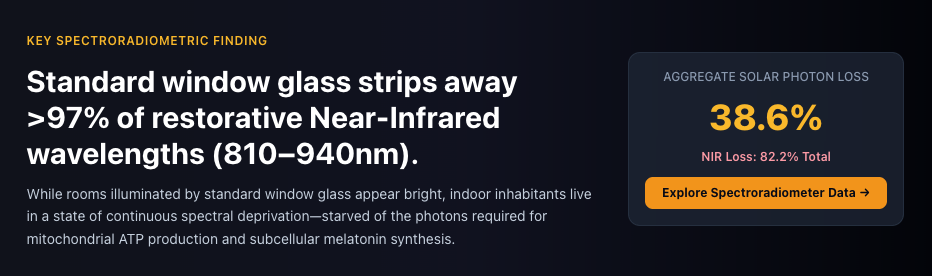
Although rooms illuminated by clear glass windows appear naturally lit to the human eye, optical physics reveals a stark disconnect. Architectural glazing is optimized to transmit visual daylight while blocking solar heat. In doing so, standard window glass acts as an aggressive optical filter: it admits blue and green wavelengths that stimulate visual opsins and circadian clock pathways, while stripping away the therapeutic red and near-infrared photons essential for mitochondrial respiration, intracellular antioxidant defense, and microvascular homeostasis.
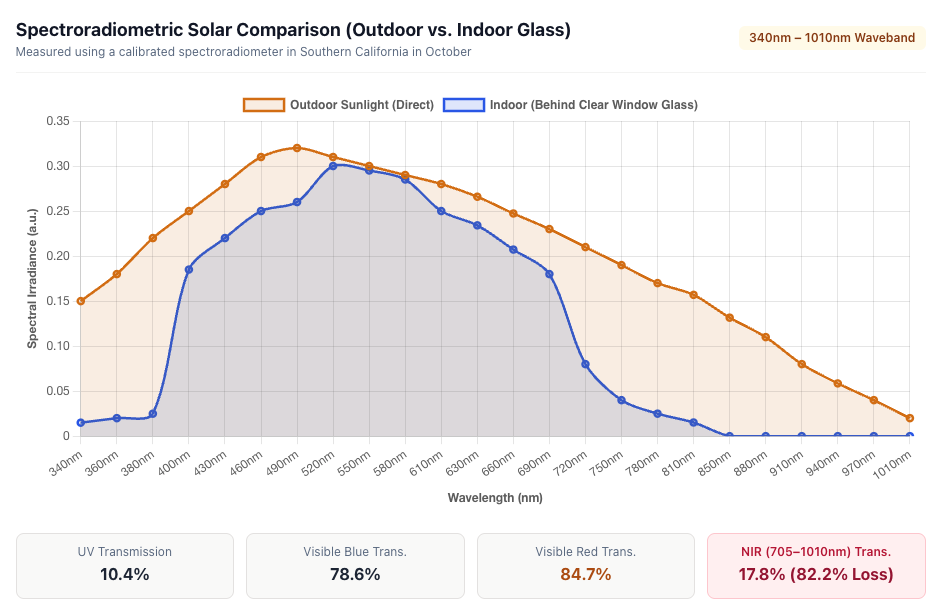
Spectroradiometric Solar Comparison (Outdoor vs. Indoor Glass)
Measured using a calibrated spectroradiometer in Southern California in October
340nm to 1010nm Waveband
2. Spectroradiometric Findings: Quantifying the Glazing Spectrum
To quantify the precise optical attenuation imposed by residential glass, field spectroradiometric measurements were recorded under midday clear-sky conditions in Southern California during October. Calibrated spectral irradiance was captured across the spectrum from 340nm to 1010nm in two consecutive setups: under direct solar exposure, and behind an untinted residential glass window.
The total solar photon sum measured outdoors across this range reached 25.681 arbitrary units (a.u.), whereas indoor irradiance behind clear glass dropped to 15.761 a.u., representing an overall solar reduction of 38.6%. However, this aggregate percentage hides critical wavelength-specific extinction rates:
| Waveband Region | Wavelength (nm) | Outdoor Irradiance | Indoor Irradiance | Transmission Rate |
|---|---|---|---|---|
| Ultraviolet (UVA/UVB) | 340 to 395 nm | 1.620 a.u. | 0.168 a.u. | 10.4% |
| Visible Blue / Violet | 400 to 495 nm | 5.377 a.u. | 4.224 a.u. | 78.6% |
| Visible Green / Yellow | 500 to 595 nm | 5.711 a.u. | 5.562 a.u. | 97.4% |
| Visible Red | 600 to 700 nm | 5.237 a.u. | 4.433 a.u. | 84.7% |
| Near-Infrared (NIR) Band | 705 to 1010 nm | 7.736 a.u. | 1.374 a.u. | 17.8% (82.2% Loss) |
While visible light passes easily through standard clear architectural glass (green/yellow light transmits at 97.4%, visible red at 84.7%, and blue at 78.6%), near-infrared transmission drops off precipitously. Specifically, at key therapeutic wavelengths such as 850nm and 940nm, window glass transmission falls to 0.00% (a total 100% loss). Ferrous oxide (Fe²⁺) impurities present in standard soda-lime silica glass generate an absorption band centered near 1050nm, creating an invisible photobiological void for indoor occupants.
3. Mitochondrial Transduction and Subcellular Melatonin
The absence of deep red and near-infrared light indoors directly impacts cellular bioenergetics. Mitochondria generate over 90% of cellular adenosine triphosphate (ATP) through the electron transport chain inside the inner mitochondrial membrane. Complex IV, also known as Cytochrome c Oxidase (CCO), acts as the primary photo-acceptor for red (620 to 680nm) and near-infrared (760 to 940nm) photons.
Photodissociation of Nitric Oxide & Subcellular Melatonin
Under oxidative stress or routine cellular metabolism, nitric oxide (NO) binds to Cytochrome c Oxidase, displacing molecular oxygen and halting ATP synthesis. Absorbed red and near-infrared photons trigger the photodissociation of inhibitory nitric oxide, restoring electron transport, accelerating ATP phosphorylation, and releasing free NO to stimulate vascular endothelial vasodilation.
Furthermore, recent research by Reiter, Tan, and Zimmerman reveals that over 90% of cellular melatonin is synthesized locally within mitochondria when stimulated by NIR light (650 to 1100nm). Unlike pineal melatonin (the hormone of darkness), mitochondrial melatonin acts as an on-demand, targeted intracellular antioxidant that protects mitochondrial DNA from oxidative damage. Spending daytime hours behind window glass deprives cells of the NIR photons needed to produce this crucial intracellular shield.
4. The Power of 30 Minutes of Outdoor Sunlight
Because window glass creates this photobiological deficit, stepping outdoors into natural daylight produces immediate, systemic physiological benefits. Dermatological research led by Dr. Richard Weller at the University of Edinburgh demonstrates that human skin stores large reservoirs of pre-formed nitrogen oxides (nitrites and nitrates).
Spending just 20 to 30 minutes in direct outdoor sun mobilizes these nitrogen oxide stores directly into systemic circulation. This triggers vascular smooth muscle relaxation, lowering systemic diastolic blood pressure by approximately 5 mmHg, a change associated epidemiologically with a 34% reduction in stroke risk and a 21% decrease in coronary heart disease mortality.
☀️ Sun Protection & Smart Solar Exposure
Always practice safe sun exposure: Prolonged, unmanaged ultraviolet B (UVB) exposure causes DNA damage and increases skin cancer risk. Wear a high-quality broad-spectrum sunscreen when spending extended time outdoors. Broad-spectrum sunscreens block harmful UV rays (290 to 400nm) while remaining completely transparent to beneficial red and near-infrared wavelengths (600 to 1000nm), allowing your body to absorb therapeutic photons safely.
5. Bridging the Deficit: Clinical Red Light Therapy Systems
When weather, geographic location, or demanding office schedules limit outdoor sunshine, targeted indoor photobiomodulation (PBM) offers a reliable, scientifically validated way to deliver missing light spectra without any ultraviolet risk.
High-output red light therapy systems engineered by TheraLuma utilize calibrated light-emitting diode (LED) arrays to deliver precise therapeutic optical bands, specifically 630nm, 660nm, 810nm, and 940nm, at clinical power densities exceeding 120 mW/cm².
TheraLuma Flex Max
1600W Multi-Wavelength Array
- Output: >120 mW/cm² at 12"
- Dosing: 50 Joules in <7 mins
- Spectrum: 630, 660, 810, 940nm
TheraLuma FlashHeal
Articulating High-Density Array
- Clinical Spot & Regional Output
- Dosing: 5 to 15 minute sessions
- Deep Joint & Muscle Protocols
TheraLuma Rejuva Pro
Compact Dermal & Facial Panel
- Targeted Dermal Matrix Output
- Dosing: 10 minute daily facial
- Collagen & Cellular Repair